Anxiety & Stress Therapy

When "Just Relax" Isn't Enough
If you are reading this, you are probably exhausted.
You might be the person who holds it all together on the outside—the reliable employee, the supportive partner, the "strong" friend—while on the inside, you are crumbling. You may feel a constant hum of dread in your chest, a mind that races with "what if" scenarios at 3 AM, or a physical exhaustion that sleep doesn't fix.
At Dandelion Wellness Counseling, we know that anxiety is more than just "being nervous." It is a heavy burden that can make you feel like you are just surviving your days rather than living them. Whether you are dealing with a constant hum of dread, 3 AM panic, or the exhaustion of high-functioning anxiety, you do not have to carry it alone.
We specialize in helping individuals move from overwhelm to empowerment—with care that is personalized, rooted in science, and always without judgment.
What Comes With Anxiety Therapy at Dandelion Wellness?
Here's what's included:
- A free 15-minute consultation to explore if we’re the right fit
- A thorough intake session where we learn your story and identify key triggers
- Weekly or bi-weekly sessions (in-person or virtual) with a licensed therapist
- Ongoing progress tracking and goal setting
- Personalized coping tools you can use between sessions
- Access to additional support such as therapy groups if needed
When you begin anxiety therapy with us, you’re not just starting sessions—you’re starting a relationship with someone who will walk beside you in your healing journey.
Is It Stress or Is It Anxiety?
While they feel similar, there is a distinct difference.
- Stress is usually a reaction to an external trigger (a deadline, a fight with a spouse). When the trigger goes away, the stress usually subsides.
- Anxiety, on the other hand, is a persistent feeling of apprehension that doesn't go away, even when life is calm. It is your body's alarm system getting stuck in the "ON" position.
If you find yourself worrying about things that haven't happened yet, or if your stress is disproportionate to the actual event, you are likely dealing with an anxiety disorder.

Why You Can't Just "Snap Out of It"
It is important to understand that anxiety is not a character flaw; it is a biological function.
Deep in your brain, you have a small almond-shaped structure called the Amygdala. Its only job is to detect threats. When it senses danger (a bear, a fire, or in modern times, an angry email), it floods your body with cortisol and adrenaline. This is the "Fight or Flight" response.
For people with anxiety, the Amygdala is hypersensitive. It perceives a messy house, a social gathering, or a vague sense of uncertainty as a life-threatening event. This is why you physically cannot "just relax"—your body is chemically prepared to run from a tiger.
Our therapy helps you retrain this alarm system. By using tools like CBT and Mindfulness, we teach your brain to distinguish between a discomfort (a deadline) and a danger (a bear), allowing your nervous system to finally stand down.
Identifying Your Symptoms
Anxiety is often misunderstood as just 'feeling nervous.' But for those living with it, it is a whole-body experience that can feel impossible to switch off. You might not even realize that your physical exhaustion, chronic headaches, or sudden irritability are actually symptoms of a nervous system on high alert. If you catch yourself thinking, 'I should be able to handle this,' while your body is signaling that it’s overwhelmed, you may recognize yourself in the list below.

Do I Have an Anxiety Disorder?
Anxiety isn't just "being nervous." It is a whole-body experience. You may recognize yourself in this list:
Mental & Emotional Symptoms:
- Catastrophizing: Automatically jumping to the worst-case scenario.
- Irritability: Snapping at loved ones over small things.
- Brain Fog: Difficulty focusing or feeling like your mind goes blank.
- Perfectionism: A fear of making mistakes or letting people down.
- Avoidance: Procrastinating on tasks or avoiding social situations to escape the feeling of dread.

The Physical Toll of Anxiety
It is not just in your head. Anxiety is a systemic physiological response. When your body is stuck in "survival mode," it redirects energy away from digestion and immune function to your muscles.
- Gastrointestinal Distress: The "gut-brain axis" is real. Many of our clients experience IBS, nausea, or loss of appetite alongside their anxiety.
- Chronic Pain: Constant muscle tension can lead to headaches, jaw pain (TMJ), and back aches.
- Sleep Disruption: High cortisol levels prevent your body from producing melatonin, leading to insomnia or waking up at 3 AM with a racing mind.
Common Anxiety Disorders We Treat
Do you feel like your symptoms don't fit into a neat box? You are not alone. Anxiety manifests in many forms, ranging from chronic, low-grade worry to sudden, debilitating panic. Understanding exactly how your anxiety operates is the first step toward dismantling it. Below are the specific types of anxiety disorders we treat most frequently in our West Islip practice.
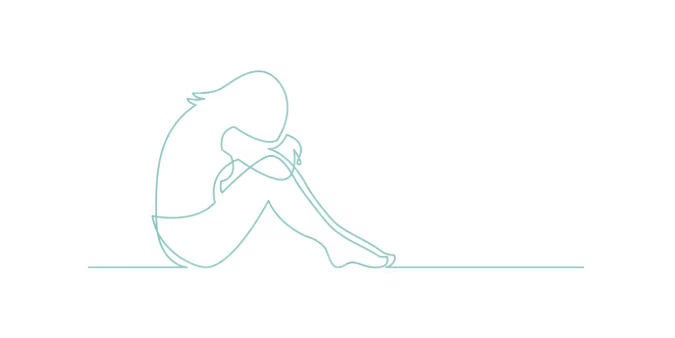
Generalized Anxiety Disorder (GAD)
The "chronic worrier." You feel anxious about everything—money, health, family, work—often without a clear reason. It feels like a cloud of doom follows you everywhere.
High-Functioning Anxiety
You look successful on paper, but you are driven by a fear of failure. You never feel "good enough," and you have trouble slowing down because productivity is your safety net.

Panic Disorder & Panic Attacks
The sudden, terrifying rush of physical fear (racing heart, dizziness) that feels like a heart attack. We teach you specific grounding techniques to stop a panic attack in its tracks.

Social Anxiety
The fear of being judged. You might replay conversations in your head for days, worry constantly about embarrassing yourself, or avoid networking and social events entirely.
.png)
Obsessive Compulsive Disorder (OCD)
Regain control of your life from intrusive thoughts and compulsions. We offer compassionate, evidence-based therapy to help you break the cycle of OCD.
How We Treat Anxiety at Dandelion Wellness
We don't just offer a listening ear; we offer a toolkit. Our approach is active and solution-focused.

Cognitive Behavioral Therapy (CBT)
We help you identify the "lie" your brain is telling you. By challenging negative thoughts (e.g., "If I fail this project, I'll get fired"), we strip them of their power.
.avif)
Mindfulness & Breathwork
You cannot think your way out of a physical panic response. We teach you how to use your breath to hack your nervous system and lower your cortisol levels immediately.

What Does a Session Actually Look Like?
New to therapy? Here is our roadmap to relief:

Lifestyle & "Hidden" Triggers
Sometimes, anxiety is fueled by things we don't even notice. We work with you to make small, manageable lifestyle shifts—like adjusting caffeine intake or improving sleep hygiene—that support your therapy rather than working against it.
Frequently Asked Questions
It depends on what is happening in your life. "Normal" anxiety is a temporary reaction to a stressor, like a big project at work, a conflict with a friend, or financial tightness. Once that problem is solved, the anxiety should fade.If you feel anxious every day without a clear reason, or if the feeling lingers for months after a stressful event has ended, it may be a sign of an anxiety disorder.
Yes. If high levels of stress go unmanaged for a long time (chronic stress), your body's nervous system can get "stuck" in survival mode. This is why we recommend seeking therapy early—learning coping skills now can prevent stress from evolving into a diagnosable disorder later.
Therapists look for the "Three D's":
- Disproportionate: Is your reaction much stronger than the actual event warrants? (e.g., having a panic attack over a typo in an email).
- Disruptive: Does it stop you from doing things? (e.g., skipping social events, calling out of work, or avoiding driving).
- Duration: Has this been happening consistently for 6 months or more?
If you answered "yes" to these, it is likely more than just stress.
Yes. Anxiety is one of the most treatable mental health conditions. Research shows that therapies like CBT can significantly reduce symptoms within 12 to 16 weeks. Most of our clients feel a sense of relief after just the first few sessions because they finally have a plan.
As therapists, we do not prescribe medication. For many clients, therapy alone is enough to manage symptoms. However, if your anxiety is severe, we can collaborate with your doctor or a psychiatrist to explore if medication might be a helpful temporary tool alongside therapy.
We teach the "5-4-3-2-1" technique: Acknowledge 5 things you see, 4 you can touch, 3 you hear, 2 you can smell, and 1 you can taste. This engages your frontal lobe and forces your brain to exit "fight or flight" mode.
Yes. We know that for some, leaving the house is the hardest part. We offer secure, HIPAA-compliant video sessions for clients in New York, Florida, and South Carolina.
Yes, even "normal" anxiety can cause butterflies in your stomach or a racing heart before a big speech. However, in an anxiety disorder, these physical symptoms can become severe and chronic—leading to insomnia, digestive issues (IBS), headaches, and panic attacks that feel like cardiac events.
Absolutely not. You do not need to be "sick enough" or have a formal disorder to benefit from counseling. If anxiety is stealing your joy or making your days harder, that is reason enough to seek support.
Still have questions?
Finding the right therapist is a deeply personal choice. Let’s connect for a brief, zero-pressure chat to see if we are the right fit for your needs.